Turning Conflict Into Cyber Resilience: A CISO Playbook for Cross-Functional Security Decisions
Executive summary
This article assumes no specific constraints (industry, size,budget, regulatory footprint). In practice, the guidance is most impactful in mid-to-largeorganizations where security outcomes depend on decisions made acrossproduct/engineering, IT operations, identity, legal, procurement, risk, and thebusiness. [1]
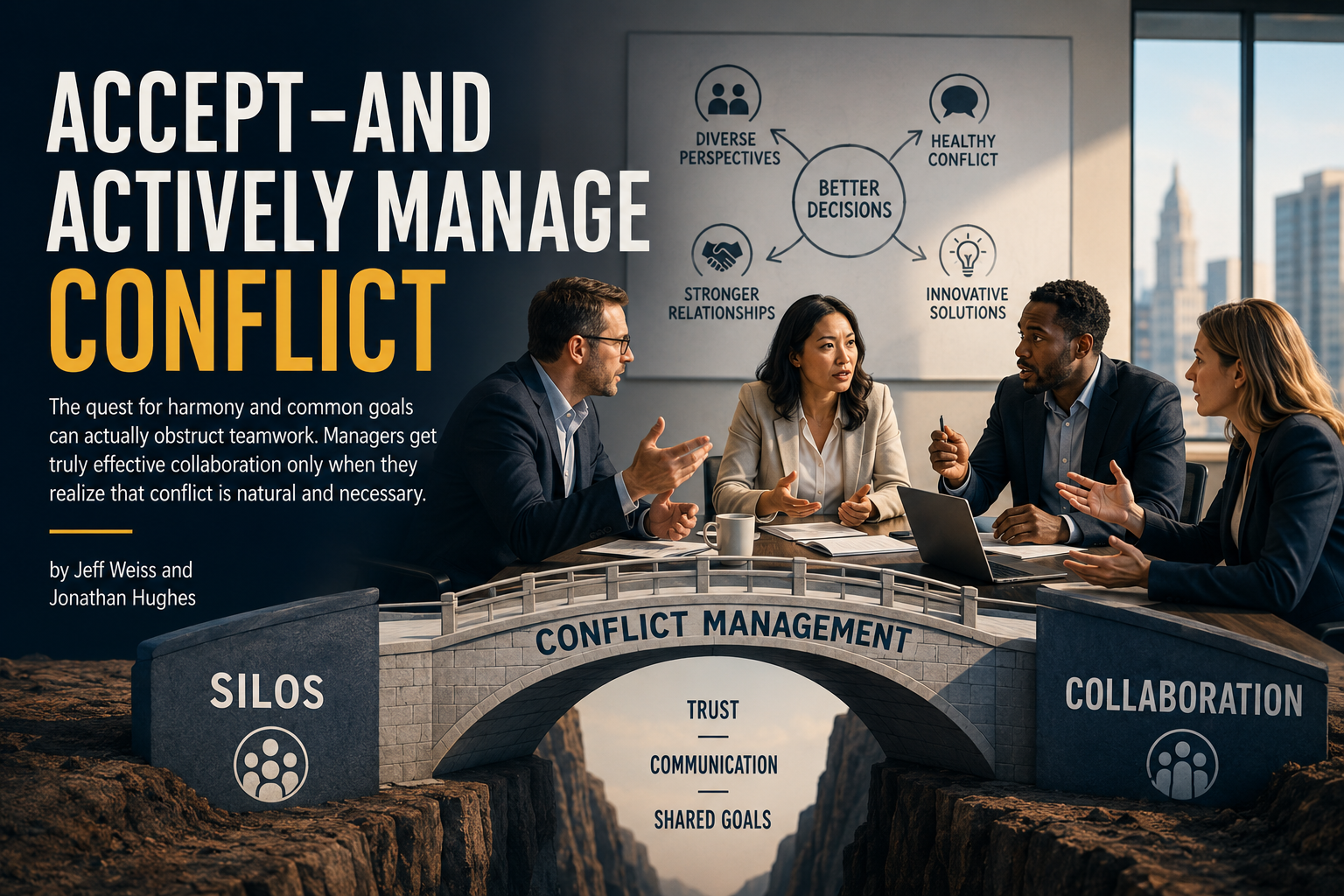
The core insight from the provided article, Want Collaboration?Accept—and Actively Manage—Conflict (Weiss & Hughes, HBR), is thatorganizations often chase “collaboration” by pursuing harmony—yet real collaboration emerges when leaders accept conflict as inevitable and build mechanisms to manage it. [2] CISOs can treat this idea as a practical operating model forsecurity governance: conflict isn’t interpersonal drama; it is the visibleboundary between competing objectives (speed vs. assurance, reliability vs.change, short-term revenue vs. long-term resilience). When unmanaged, thatconflict slows response and increases risk. When actively managed, it becomes adecision engine that accelerates risk-informed execution. [3]
This matters now because:
· The threat environment is fastand extortion-focused: Verizon’s 2024 DBIR reports that roughlyone-third of breaches involved ransomware or some other extortion technique,and notes “pure extortion” as a growing component of breaches. [4] Fast-moving vulnerability exploitation also pressures decision-makingspeed: the DBIR reports a median of 5 days from vulnerabilitypublication to first scan for vulnerabilities in CISA’s KEV list (vs. 68 daysfor non-KEV). [5]
· The economic stakes are large:IBM’s 2024 Cost of a Data Breach report puts the global average total costat USD 4.88M. [6]
· Governance expectations havesharpened. NIST CSF 2.0 introduced GOVERN as a core function,emphasizing established, communicated, and monitored cybersecurity riskstrategy, expectations, and policy. [1] Public companies also face requirements for incident and governancedisclosures under the SEC’s 2023 final rule, including an emphasis on processesto assess/manage cyber risk and board oversight, and an Item 1.05 Form 8‑Kdeadline tied to a “four business day” window after materiality determination. [7]
· Talent and operating constraintsamplify friction. ISC2’s 2024 workforce study reports 67% of respondentsindicated a staffing shortage, and highlights that hiring managers prioritizenontechnical skills like problem-solving, teamwork/collaboration, andcommunication—capabilities that directly determine whether conflict becomesproductive. [8]
Bottom line for CISOs: treat cross-functionalconflict as a managed “control surface” of governance. Implement a lightweight,repeatable Security Decision & Conflict Operating System that (1)standardizes how disagreements get resolved, (2) clarifies trade-off criteriatied to risk appetite and mission priorities, (3) enforces joint escalation andtransparency, and (4) captures conflict patterns as risk intelligence. Thisaligns naturally with CSF 2.0’s emphasis on governance and communication. [9]
Weiss & Hughes argue that many “collaboration” initiatives failbecause they treat symptoms (silos, slow decisions, inadequate teamwork)while ignoring the root cause: unmanaged conflict. [2] They also warn against three common myths—(1) collaboration equals“teaming,” (2) incentives will solve collaboration, (3) structure can createcollaboration—because these approaches often fail to address the realtrade-offs and disagreements that arise across organizational boundaries. [2]
The article proposes a pragmatic framework: three strategies at thepoint of conflict (where the disagreement occurs) and three strategiesupon escalation (when conflict moves up the chain), plus the meta-practiceof learning from conflict patterns as a diagnostic resource. [10] Key mechanisms include:
· A common method for resolving conflict, embedded into day-to-day processes. [11]
· Explicit trade-off criteria from leadership, so people can make zero-sum choices without endlessdebate. [12]
· Treating escalation as coaching,not a “hot potato” toss. [13]
· Transparency in escalated decision-making—communicate rationale and trade-offs, notjust the verdict. [15]
· Tracking conflict to identify systemic strains and recurring issues—the “learning latentin conflict.” [16]
Translating directlyto CISO priorities
ACISO’s hardest problems are frequently conflict problems wearing a technicaldisguise:
Riskmanagement and governance. Risk acceptance,compensating controls, and prioritization disputes are conflicts betweenbusiness objectives and control requirements. CSF 2.0 explicitly emphasizesgovernance and cybersecurity risk communication, with “GOVERN” and a statedgoal of enabling organizations to “communicate” cybersecurity risks andexpectations using a common language. [1] TheHBR framework supplies the missing operating mechanics for that governance (howdecisions actually get made under pressure). [17]
Incident response and resilience. Incidents force rapiddecisions that cross legal, HR, public affairs, and third parties. NIST SP800-61r3 explicitly frames incident response as integrated across CSF 2.0activities to improve detection/response/recovery efficiency and reduceincident impact, and it highlights dependency on coordinated roles (legal, HR,asset owners, service providers) and clearly defined authority/coordination. [18]These dependencies are exactly where unmanaged conflict causes delay.
Cloudand shared responsibility. Cloud security disputesoften originate from ambiguity about shared responsibility with providers andinternal platform teams; NIST SP 800-61r3 calls out the shared responsibilitymodel and the need for contracts to define responsibilities, information flows,and authority—frequent sources of friction during incidents. [18]
Supply chain risk. NIST’s supply chain guidance highlightsreduced visibility and concerns about insecure or counterfeitproducts/services; it advises integrating C‑SCRM into broader risk managementwith strategy, policies, plans, and assessments. [19]Disagreements between procurement, engineering, vendor management, and securityare normal—so the question is whether the organization can resolve them quicklyand consistently.
Talent and operating model. Security work increasinglydepends on nontechnical skills. ISC2 documents demand forteamwork/collaboration and communication skills in cybersecurity hiring andshows that staffing shortages persist. [8] TheHBR framework is, in effect, a talent multiplier: it reduces wastedsenior time and increases decision throughput. [20]
Metrics. HBR’s emphasis on making escalations transparent and tracking conflictpatterns can be operationalized as governance metrics and decision-qualityindicators, complementing traditional control coverage and incident KPIs. [21]
Security leaders do not need another “collaboration workshop.” Theyneed an operating model that fits the framework reality they alreadylive in:
NIST CSF 2.0 is designed for broad audiences—including executives andboards—and provides a taxonomy of outcomes to “understand, assess, prioritize,and communicate” cybersecurity efforts. [1] It also explicitly defines GOVERN as establishing,communicating, and monitoring cybersecurity risk strategy/expectations/policy. [1] The CSF is “not prescriptive” about how outcomes are achieved—leavingCISOs room (and responsibility) to define decision mechanisms. [1]
CISA’s Cybersecurity Performance Goals 2.0 (CPG 2.0) adds a governancecomponent, emphasizes accountability and integration into day-to-dayoperations, and is framed as streamlined/outcome-driven protections with benchmarkingand measurable risk reduction. [22] The CPG 2.0 document also explicitly includescost/impact/ease-of-implementation guidance for goals, and positions the CPGsas a “floor—not a ceiling,” mapping to CSF 2.0 while remainingnon-comprehensive. [23] This structure mirrors the HBR “trade-off criteria” concept (maketrade-offs explicit rather than moralizing about “do what’s right”). [24]
ISO/IEC 27001:2022 remains the dominant ISMS requirements standard andexplicitly frames information security as a management system for riskmanagement and improvement. [25] For organizations transitioning certifications, certification bodiesdocument a 3-year transition window ending October 31, 2025, which cancreate modernization and prioritization conflicts that should be handledthrough explicit criteria and joint escalation. [26]
MITRE ATT&CK provides a shared taxonomy of adversarytactics/techniques and explicitly positions itself as a common languagefor defenders to talk about threats and strategies. [27] In practice, ATT&CK can reduce “semantic conflict” bystandardizing what teams mean when they say “lateral movement,” “credentialaccess,” or “impact.” [28]
NIST’s SSDF (SP 800-218) gives a common vocabulary for secure softwaredevelopment and explicitly supports communication with suppliers andacquisition processes—areas of frequent cross-functional conflict (securityrequirements vs. delivery timelines; supplier constraints vs. internalexpectations). [29]
NIST IR 8286 Rev. 1 updates guidance on integrating cybersecurity riskinto ERM, emphasizing that directors and senior leaders need a clearunderstanding of cyber risk posture and that cybersecurity risk decisions mustbe understood in the context of enterprise objectives. [30] This is the governance foundation that makes the HBR transparency andcriteria-setting mechanisms “board-real.” [31]
Finally, industry data continues to emphasize speed and coordinationpressures. Verizon’s DBIR shows extortion prevalence and rapid exploitationtimelines. [32] IBM quantifies breach costs and highlights business disruptiondrivers. [6] These data points strengthen the business case for reducing decisionfriction.
Implementationblueprint (roles, steps, timelines)
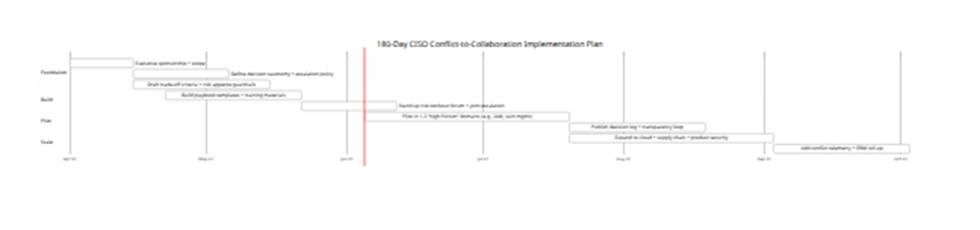
Therecommended cadence is 180 days to institutionalize (with measurableearly wins in 30–90 days). This is intentionally aligned with how CSF 2.0expects organizations to establish governance outcomes without prescribingimplementation detail. [1]
Recommendation details
Security Decision& Conflict Playbook (High priority) This is the CISO analog to the article’s call for a “common method forresolving conflict” that reduces transaction costs and avoids defaulting to“who’s right” debates. [11]
Implementation steps:
· Define a decision taxonomy:(a) risk acceptance/exception, (b) vulnerability remediation timing, (c)identity/access exceptions, (d) cloud configuration deviations, (e) supplieronboarding/security clauses, (f) incident response authority decisions. Thismirrors CSF’s intent to provide a common language for communicating risks andexpectations. [1]
· Standardize a one-page DecisionRecord template:
· decision statement; optionsconsidered; risk impact; trade-off criteria used; decision owner; dissentingviews; “revisit trigger” (what evidence would make us revisit). This supportsthe transparency principle (share rationale, not just verdict). [15]
· Embed the method into existingoperational workflows (architecture review, change management, vendor review),because the article warns that isolated “appeals court” mechanisms wither. [2]
Roles:
· Accountable: CISO (or Deputy CISO)
· Responsible: Security GRC lead (templates), Security Architecture (integration),PMO (cadence)
· Risks:bureaucracy perception; mitigate by limiting the playbook to a defined decisionset and using lightweight templates.
PublishedTrade-off Criteria & Risk Appetite Guardrails (High priority) The article shows that exhortations like “do what’s right” fail when trade-offsare real; leadership must articulate criteria. [12] For CISOs, thisbecomes the operational bridge between CSF 2.0 “GOVERN” expectations andday-to-day choices. [1]
Implementation steps:
· Create a concise Cyber RiskAppetite & Trade-off Charter (2 pages max):
· what must never be traded off(e.g., legal obligations, safety, privileged access baseline)
· what can be traded and how (e.g.,“ship with compensating controls if…”; “defer patching if matched conditionsare met”).
· Adopt a criteria grid(inspired by the HBR “Build/Buy/Ally” trade-off tool) for frequent CISOdecisions:
· Borrow CPG 2.0’s framing of cost/impact/easescoring for controls to make trade-offs explainable to executives and boards. [23]
· Roll-up key decisions into cyberrisk registers that can integrate into ERM, consistent with NIST IR 8286’semphasis on risk registers and enterprise context. [30]
Joint escalation +Cyber Risk Workout forum (Medium priority) The article highlights joint escalation to prevent biased, unilateral handoffsand to increase accountability; it provides an example where unilateralescalation paralyzed leadership until joint escalation protocols were enforced.[14] CISA’s CPG 2.0messaging similarly emphasizes governance and integration into dailyoperations. [22]
Implementation steps:
· Implement a “no unilateralescalation” rule for defined issue types (risk exceptions above threshold,patch deferrals exceeding SLA, major supplier security clause disputes,incident “materiality determination readiness” disputes).
· Require a joint escalation memo(1 page) including:
· both positions; shared facts; whathas been tried; time constraints; options + recommended path; what decision isneeded and by whom.
· Create a weekly or biweekly CyberRisk Workout meeting:
· 30 minutes, standing agenda,limited to “cannot-resolve-locally” issues.
· Publish outcomes internally with ashort rationale statement to make decision patterns visible and reducespeculation (“who won/ lost”), consistent with the transparency principle. [15]
· Risks:meeting becomes theater; mitigate via strict eligibility rules and pre-worktemplates.
Manager coaching& talent enablement (Medium priority) Weiss & Hughes argue that escalation should be used as coaching soemployees learn to resolve disputes rather than reflexively punting issuesupward. [13] This dovetails withcybersecurity workforce realities: staffing shortages are widespread, andhiring managers prioritize collaboration and communication skills. [8]
Implementation steps:
· Train security leaders (and keypartner leaders in IT/engineering) on a coaching script:
· clarify decision rights, ensurethe right parties are consulted, break decisions into sub-issues, define how adecision will be made—mirroring the article’s IBM coaching example. [13]
· Add “conflict coaching”expectations to leadership OKRs:
· e.g., “reduce escalations by 25%while maintaining SLA and stakeholder satisfaction.”
· Embed learning into incidentpreparedness: NIST 800-61r3 emphasizes broader coordination across legal, HR,physical security, asset owners, and contracted service providers, and stressesclarity of responsibilities, information flows, and authority—areas wherecoaching avoids repeated failure modes. [18]
· Use targeted enablement inhigh-friction domains:
· detection/response teams oftenface budget and skill constraints; SANS 2024 reports budget constraints andskilled personnel needs as major obstacles, with 64% integrating automatedresponse but only 16% fully automated. [39]
Roles:
· Accountable: CISO (people strategy) + HR business partner
· Responsible: Security leadership team; Learning & Development
· Cost/effort: moderate training time; minimal tooling.
· Risk:inconsistent modeling; mitigate by having CISO/CIO visibly use the approach intop forums.
Conflict telemetryas risk intelligence (Medium priority) The article explicitly proposes tracking conflict and examining causes toidentify hidden organizational strains; it describes conflict as a “valuableresource” that reveals systemic issues. [16] For CISOs, thisbecomes a leading indicator system that feeds ERM integration per NIST IR 8286.[30]
Implementation steps:
· Define what you will track(minimize noise):
· escalations, risk exceptions,repeated policy deviations, delayed patching decisions, supplier clausedisputes, incident decision inflection points, and “shadow IT / shadow data”cases (relevant to breach impact and lifecycle). [41]
· Create a monthly Conflict-to-RiskReview:
· top 5 themes; what enterprisestrains they reflect (capacity, unclear ownership, incompatible metrics); whatsystemic fix is required. [42]
· Feed themes into:
· security roadmap; policy updates;investment asks; and ERM risk registers (NIST IR 8286 series). [30]
Suggested boardbriefing language (adaptable template)
Opening(why this matters): “We are not failing because teams won’t collaborate—we are failing when wetreat disagreement as a problem to suppress instead of a signal to manage. In acomplex enterprise, conflict is inevitable; our goal is to make conflictproductive and fast, because cyber risk moves faster than our decision cycles.”[44]
Threatand impact framing: “External pressure is rising: about one-third of breaches involve ransomware orextortion, and exploited vulnerabilities can see scanning activity withindays—decision delays matter.” [32] “The financial exposure is also measurable: the global average cost of a breachin IBM’s 2024 benchmark is USD 4.88M, driven heavily by disruption andresponse.” [6]
Governanceframing (what good looks like): “NIST CSF 2.0 elevates ‘GOVERN’ as a core function. We are implementing alightweight governance operating model that standardizes how we resolvesecurity trade-offs, document decisions, and reduce repeated escalation.” [1] “This also supports disclosure-readiness expectations. Under SEC rules,material cybersecurity incidents require timely reporting and companies mustdescribe their cyber risk management and governance processes; our modelimproves clarity and auditability of decision paths.” [7]
Theask (what you want from the board): “We are requesting endorsement of: (1) explicit risk appetite/trade-offcriteria, (2) a joint escalation rule for defined cyber decisions, and (3)quarterly review of a small set of governance and resilience metrics. This is alow-cost change that increases speed, accountability, and consistency.”
This dashboard intentionally mixes (a) security outcomes and (b)decision/governance throughput. The second category is what mostsecurity programs lack, but it is the direct lever implied by theconflict-management framework. [46]
CSF-aligned area
Metric
Definition / formula
Target example
Data source
Cadence
Board relevance
Govern
Decision latency
Median days from intake → decision for in-scope cyber decisions
Treating the playbook as bureaucracy instead of acceleration. If the method becomes paperwork, teams will route around it (a failuremode described in the article’s “structure for collaboration” myth). Mitigateby tightly scoping which decisions require full documentation, keepingtemplates to one page, and measuring time-to-decision as a first-class KPI. [11]
Unclear decision rights (“everyone must be a decision maker”). This fuels deadlock and escalations. Mitigate by explicitly definingdecision owners and consultation requirements within the playbook and by usingcoaching when escalation occurs. [51]
One-sided escalations that harden positions.The article shows how unilateral escalation can create “my manager’s view”stalemates. Enforce joint escalation for defined cybersecurity decision classesand refuse unilateral escalations. [52]
Failure to communicate the “why” behind decisions. When people only hear verdicts, they can’t generalize future decisionsand will assume politics; the article recommends transparency in escalatedconflict rationale. Build a lightweight decision log and publish pattern-levelrationales. [15]
Punitive use of conflict telemetry. Trackingconflict can look like surveillance, chilling upward reporting. Mitigate byexplicitly positioning telemetry as a systems-improvement tool and by rewardingteams for surfacing recurring friction that becomes roadmap work. [36]
Misalignment with external obligations and disclosure timelines. During incidents, disagreement about materiality, timing, andcommunications can create legal risk. Align incident decision pathways withincident response guidance and disclosure-readiness expectations (e.g., SECItem 1.05 timing concept), and test through tabletop exercises. [53]
Underinvesting in the human layer. SANS datashows skilled personnel and budget constraints as key blockers indetection/response modernization; ignoring the people side will cause conflictto recur. Mitigate by investing in coaching, role clarity, and targetedautomation where it reduces toil. [54]
Not integrating supplier and software-security disputes into the sameoperating model. Supply chain and software decisionsare recurring flashpoints; treat them as first-class decision types and useSSDF language as a common vocabulary with suppliers. [48]
· Proudfoot, Cram, Madnick, &Coden (MIS Quarterly Executive). The Importance of Board Member Actions forCybersecurity Governance and Risk Management (Dec 2023). [63]
Turning Conflict Into Cyber Resilience: A CISO Playbook for Cross-Functional Security Decisions
Executive summary
This article assumes no specific constraints (industry, size,budget, regulatory footprint). In practice, the guidance is most impactful in mid-to-largeorganizations where security outcomes depend on decisions made acrossproduct/engineering, IT operations, identity, legal, procurement, risk, and thebusiness. [1]
The core insight from the provided article, Want Collaboration?Accept—and Actively Manage—Conflict (Weiss & Hughes, HBR), is thatorganizations often chase “collaboration” by pursuing harmony—yet real collaboration emerges when leaders accept conflict as inevitable and build mechanisms to manage it. [2] CISOs can treat this idea as a practical operating model forsecurity governance: conflict isn’t interpersonal drama; it is the visibleboundary between competing objectives (speed vs. assurance, reliability vs.change, short-term revenue vs. long-term resilience). When unmanaged, thatconflict slows response and increases risk. When actively managed, it becomes adecision engine that accelerates risk-informed execution. [3]
This matters now because:
· The threat environment is fastand extortion-focused: Verizon’s 2024 DBIR reports that roughlyone-third of breaches involved ransomware or some other extortion technique,and notes “pure extortion” as a growing component of breaches. [4] Fast-moving vulnerability exploitation also pressures decision-makingspeed: the DBIR reports a median of 5 days from vulnerabilitypublication to first scan for vulnerabilities in CISA’s KEV list (vs. 68 daysfor non-KEV). [5]
· The economic stakes are large:IBM’s 2024 Cost of a Data Breach report puts the global average total costat USD 4.88M. [6]
· Governance expectations havesharpened. NIST CSF 2.0 introduced GOVERN as a core function,emphasizing established, communicated, and monitored cybersecurity riskstrategy, expectations, and policy. [1] Public companies also face requirements for incident and governancedisclosures under the SEC’s 2023 final rule, including an emphasis on processesto assess/manage cyber risk and board oversight, and an Item 1.05 Form 8‑Kdeadline tied to a “four business day” window after materiality determination. [7]
· Talent and operating constraintsamplify friction. ISC2’s 2024 workforce study reports 67% of respondentsindicated a staffing shortage, and highlights that hiring managers prioritizenontechnical skills like problem-solving, teamwork/collaboration, andcommunication—capabilities that directly determine whether conflict becomesproductive. [8]
Bottom line for CISOs: treat cross-functionalconflict as a managed “control surface” of governance. Implement a lightweight,repeatable Security Decision & Conflict Operating System that (1)standardizes how disagreements get resolved, (2) clarifies trade-off criteriatied to risk appetite and mission priorities, (3) enforces joint escalation andtransparency, and (4) captures conflict patterns as risk intelligence. Thisaligns naturally with CSF 2.0’s emphasis on governance and communication. [9]
Weiss & Hughes argue that many “collaboration” initiatives failbecause they treat symptoms (silos, slow decisions, inadequate teamwork)while ignoring the root cause: unmanaged conflict. [2] They also warn against three common myths—(1) collaboration equals“teaming,” (2) incentives will solve collaboration, (3) structure can createcollaboration—because these approaches often fail to address the realtrade-offs and disagreements that arise across organizational boundaries. [2]
The article proposes a pragmatic framework: three strategies at thepoint of conflict (where the disagreement occurs) and three strategiesupon escalation (when conflict moves up the chain), plus the meta-practiceof learning from conflict patterns as a diagnostic resource. [10] Key mechanisms include:
· A common method for resolving conflict, embedded into day-to-day processes. [11]
· Explicit trade-off criteria from leadership, so people can make zero-sum choices without endlessdebate. [12]
· Treating escalation as coaching,not a “hot potato” toss. [13]
· Transparency in escalated decision-making—communicate rationale and trade-offs, notjust the verdict. [15]
· Tracking conflict to identify systemic strains and recurring issues—the “learning latentin conflict.” [16]
Translating directlyto CISO priorities
ACISO’s hardest problems are frequently conflict problems wearing a technicaldisguise:
Riskmanagement and governance. Risk acceptance,compensating controls, and prioritization disputes are conflicts betweenbusiness objectives and control requirements. CSF 2.0 explicitly emphasizesgovernance and cybersecurity risk communication, with “GOVERN” and a statedgoal of enabling organizations to “communicate” cybersecurity risks andexpectations using a common language. [1] TheHBR framework supplies the missing operating mechanics for that governance (howdecisions actually get made under pressure). [17]
Incident response and resilience. Incidents force rapiddecisions that cross legal, HR, public affairs, and third parties. NIST SP800-61r3 explicitly frames incident response as integrated across CSF 2.0activities to improve detection/response/recovery efficiency and reduceincident impact, and it highlights dependency on coordinated roles (legal, HR,asset owners, service providers) and clearly defined authority/coordination. [18]These dependencies are exactly where unmanaged conflict causes delay.
Cloudand shared responsibility. Cloud security disputesoften originate from ambiguity about shared responsibility with providers andinternal platform teams; NIST SP 800-61r3 calls out the shared responsibilitymodel and the need for contracts to define responsibilities, information flows,and authority—frequent sources of friction during incidents. [18]
Supply chain risk. NIST’s supply chain guidance highlightsreduced visibility and concerns about insecure or counterfeitproducts/services; it advises integrating C‑SCRM into broader risk managementwith strategy, policies, plans, and assessments. [19]Disagreements between procurement, engineering, vendor management, and securityare normal—so the question is whether the organization can resolve them quicklyand consistently.
Talent and operating model. Security work increasinglydepends on nontechnical skills. ISC2 documents demand forteamwork/collaboration and communication skills in cybersecurity hiring andshows that staffing shortages persist. [8] TheHBR framework is, in effect, a talent multiplier: it reduces wastedsenior time and increases decision throughput. [20]
Metrics. HBR’s emphasis on making escalations transparent and tracking conflictpatterns can be operationalized as governance metrics and decision-qualityindicators, complementing traditional control coverage and incident KPIs. [21]
Security leaders do not need another “collaboration workshop.” Theyneed an operating model that fits the framework reality they alreadylive in:
NIST CSF 2.0 is designed for broad audiences—including executives andboards—and provides a taxonomy of outcomes to “understand, assess, prioritize,and communicate” cybersecurity efforts. [1] It also explicitly defines GOVERN as establishing,communicating, and monitoring cybersecurity risk strategy/expectations/policy. [1] The CSF is “not prescriptive” about how outcomes are achieved—leavingCISOs room (and responsibility) to define decision mechanisms. [1]
CISA’s Cybersecurity Performance Goals 2.0 (CPG 2.0) adds a governancecomponent, emphasizes accountability and integration into day-to-dayoperations, and is framed as streamlined/outcome-driven protections with benchmarkingand measurable risk reduction. [22] The CPG 2.0 document also explicitly includescost/impact/ease-of-implementation guidance for goals, and positions the CPGsas a “floor—not a ceiling,” mapping to CSF 2.0 while remainingnon-comprehensive. [23] This structure mirrors the HBR “trade-off criteria” concept (maketrade-offs explicit rather than moralizing about “do what’s right”). [24]
ISO/IEC 27001:2022 remains the dominant ISMS requirements standard andexplicitly frames information security as a management system for riskmanagement and improvement. [25] For organizations transitioning certifications, certification bodiesdocument a 3-year transition window ending October 31, 2025, which cancreate modernization and prioritization conflicts that should be handledthrough explicit criteria and joint escalation. [26]
MITRE ATT&CK provides a shared taxonomy of adversarytactics/techniques and explicitly positions itself as a common languagefor defenders to talk about threats and strategies. [27] In practice, ATT&CK can reduce “semantic conflict” bystandardizing what teams mean when they say “lateral movement,” “credentialaccess,” or “impact.” [28]
NIST’s SSDF (SP 800-218) gives a common vocabulary for secure softwaredevelopment and explicitly supports communication with suppliers andacquisition processes—areas of frequent cross-functional conflict (securityrequirements vs. delivery timelines; supplier constraints vs. internalexpectations). [29]
NIST IR 8286 Rev. 1 updates guidance on integrating cybersecurity riskinto ERM, emphasizing that directors and senior leaders need a clearunderstanding of cyber risk posture and that cybersecurity risk decisions mustbe understood in the context of enterprise objectives. [30] This is the governance foundation that makes the HBR transparency andcriteria-setting mechanisms “board-real.” [31]
Finally, industry data continues to emphasize speed and coordinationpressures. Verizon’s DBIR shows extortion prevalence and rapid exploitationtimelines. [32] IBM quantifies breach costs and highlights business disruptiondrivers. [6] These data points strengthen the business case for reducing decisionfriction.
Implementationblueprint (roles, steps, timelines)
Therecommended cadence is 180 days to institutionalize (with measurableearly wins in 30–90 days). This is intentionally aligned with how CSF 2.0expects organizations to establish governance outcomes without prescribingimplementation detail. [1]
Recommendation details
Security Decision& Conflict Playbook (High priority) This is the CISO analog to the article’s call for a “common method forresolving conflict” that reduces transaction costs and avoids defaulting to“who’s right” debates. [11]
Implementation steps:
· Define a decision taxonomy:(a) risk acceptance/exception, (b) vulnerability remediation timing, (c)identity/access exceptions, (d) cloud configuration deviations, (e) supplieronboarding/security clauses, (f) incident response authority decisions. Thismirrors CSF’s intent to provide a common language for communicating risks andexpectations. [1]
· Standardize a one-page DecisionRecord template:
· decision statement; optionsconsidered; risk impact; trade-off criteria used; decision owner; dissentingviews; “revisit trigger” (what evidence would make us revisit). This supportsthe transparency principle (share rationale, not just verdict). [15]
· Embed the method into existingoperational workflows (architecture review, change management, vendor review),because the article warns that isolated “appeals court” mechanisms wither. [2]
Roles:
· Accountable: CISO (or Deputy CISO)
· Responsible: Security GRC lead (templates), Security Architecture (integration),PMO (cadence)
· Risks:bureaucracy perception; mitigate by limiting the playbook to a defined decisionset and using lightweight templates.
PublishedTrade-off Criteria & Risk Appetite Guardrails (High priority) The article shows that exhortations like “do what’s right” fail when trade-offsare real; leadership must articulate criteria. [12] For CISOs, thisbecomes the operational bridge between CSF 2.0 “GOVERN” expectations andday-to-day choices. [1]
Implementation steps:
· Create a concise Cyber RiskAppetite & Trade-off Charter (2 pages max):
· what must never be traded off(e.g., legal obligations, safety, privileged access baseline)
· what can be traded and how (e.g.,“ship with compensating controls if…”; “defer patching if matched conditionsare met”).
· Adopt a criteria grid(inspired by the HBR “Build/Buy/Ally” trade-off tool) for frequent CISOdecisions:
· Borrow CPG 2.0’s framing of cost/impact/easescoring for controls to make trade-offs explainable to executives and boards. [23]
· Roll-up key decisions into cyberrisk registers that can integrate into ERM, consistent with NIST IR 8286’semphasis on risk registers and enterprise context. [30]
Joint escalation +Cyber Risk Workout forum (Medium priority) The article highlights joint escalation to prevent biased, unilateral handoffsand to increase accountability; it provides an example where unilateralescalation paralyzed leadership until joint escalation protocols were enforced.[14] CISA’s CPG 2.0messaging similarly emphasizes governance and integration into dailyoperations. [22]
Implementation steps:
· Implement a “no unilateralescalation” rule for defined issue types (risk exceptions above threshold,patch deferrals exceeding SLA, major supplier security clause disputes,incident “materiality determination readiness” disputes).
· Require a joint escalation memo(1 page) including:
· both positions; shared facts; whathas been tried; time constraints; options + recommended path; what decision isneeded and by whom.
· Create a weekly or biweekly CyberRisk Workout meeting:
· 30 minutes, standing agenda,limited to “cannot-resolve-locally” issues.
· Publish outcomes internally with ashort rationale statement to make decision patterns visible and reducespeculation (“who won/ lost”), consistent with the transparency principle. [15]
· Risks:meeting becomes theater; mitigate via strict eligibility rules and pre-worktemplates.
Manager coaching& talent enablement (Medium priority) Weiss & Hughes argue that escalation should be used as coaching soemployees learn to resolve disputes rather than reflexively punting issuesupward. [13] This dovetails withcybersecurity workforce realities: staffing shortages are widespread, andhiring managers prioritize collaboration and communication skills. [8]
Implementation steps:
· Train security leaders (and keypartner leaders in IT/engineering) on a coaching script:
· clarify decision rights, ensurethe right parties are consulted, break decisions into sub-issues, define how adecision will be made—mirroring the article’s IBM coaching example. [13]
· Add “conflict coaching”expectations to leadership OKRs:
· e.g., “reduce escalations by 25%while maintaining SLA and stakeholder satisfaction.”
· Embed learning into incidentpreparedness: NIST 800-61r3 emphasizes broader coordination across legal, HR,physical security, asset owners, and contracted service providers, and stressesclarity of responsibilities, information flows, and authority—areas wherecoaching avoids repeated failure modes. [18]
· Use targeted enablement inhigh-friction domains:
· detection/response teams oftenface budget and skill constraints; SANS 2024 reports budget constraints andskilled personnel needs as major obstacles, with 64% integrating automatedresponse but only 16% fully automated. [39]
Roles:
· Accountable: CISO (people strategy) + HR business partner
· Responsible: Security leadership team; Learning & Development
· Cost/effort: moderate training time; minimal tooling.
· Risk:inconsistent modeling; mitigate by having CISO/CIO visibly use the approach intop forums.
Conflict telemetryas risk intelligence (Medium priority) The article explicitly proposes tracking conflict and examining causes toidentify hidden organizational strains; it describes conflict as a “valuableresource” that reveals systemic issues. [16] For CISOs, thisbecomes a leading indicator system that feeds ERM integration per NIST IR 8286.[30]
Implementation steps:
· Define what you will track(minimize noise):
· escalations, risk exceptions,repeated policy deviations, delayed patching decisions, supplier clausedisputes, incident decision inflection points, and “shadow IT / shadow data”cases (relevant to breach impact and lifecycle). [41]
· Create a monthly Conflict-to-RiskReview:
· top 5 themes; what enterprisestrains they reflect (capacity, unclear ownership, incompatible metrics); whatsystemic fix is required. [42]
· Feed themes into:
· security roadmap; policy updates;investment asks; and ERM risk registers (NIST IR 8286 series). [30]
Suggested boardbriefing language (adaptable template)
Opening(why this matters): “We are not failing because teams won’t collaborate—we are failing when wetreat disagreement as a problem to suppress instead of a signal to manage. In acomplex enterprise, conflict is inevitable; our goal is to make conflictproductive and fast, because cyber risk moves faster than our decision cycles.”[44]
Threatand impact framing: “External pressure is rising: about one-third of breaches involve ransomware orextortion, and exploited vulnerabilities can see scanning activity withindays—decision delays matter.” [32] “The financial exposure is also measurable: the global average cost of a breachin IBM’s 2024 benchmark is USD 4.88M, driven heavily by disruption andresponse.” [6]
Governanceframing (what good looks like): “NIST CSF 2.0 elevates ‘GOVERN’ as a core function. We are implementing alightweight governance operating model that standardizes how we resolvesecurity trade-offs, document decisions, and reduce repeated escalation.” [1] “This also supports disclosure-readiness expectations. Under SEC rules,material cybersecurity incidents require timely reporting and companies mustdescribe their cyber risk management and governance processes; our modelimproves clarity and auditability of decision paths.” [7]
Theask (what you want from the board): “We are requesting endorsement of: (1) explicit risk appetite/trade-offcriteria, (2) a joint escalation rule for defined cyber decisions, and (3)quarterly review of a small set of governance and resilience metrics. This is alow-cost change that increases speed, accountability, and consistency.”
This dashboard intentionally mixes (a) security outcomes and (b)decision/governance throughput. The second category is what mostsecurity programs lack, but it is the direct lever implied by theconflict-management framework. [46]
CSF-aligned area
Metric
Definition / formula
Target example
Data source
Cadence
Board relevance
Govern
Decision latency
Median days from intake → decision for in-scope cyber decisions
Treating the playbook as bureaucracy instead of acceleration. If the method becomes paperwork, teams will route around it (a failuremode described in the article’s “structure for collaboration” myth). Mitigateby tightly scoping which decisions require full documentation, keepingtemplates to one page, and measuring time-to-decision as a first-class KPI. [11]
Unclear decision rights (“everyone must be a decision maker”). This fuels deadlock and escalations. Mitigate by explicitly definingdecision owners and consultation requirements within the playbook and by usingcoaching when escalation occurs. [51]
One-sided escalations that harden positions.The article shows how unilateral escalation can create “my manager’s view”stalemates. Enforce joint escalation for defined cybersecurity decision classesand refuse unilateral escalations. [52]
Failure to communicate the “why” behind decisions. When people only hear verdicts, they can’t generalize future decisionsand will assume politics; the article recommends transparency in escalatedconflict rationale. Build a lightweight decision log and publish pattern-levelrationales. [15]
Punitive use of conflict telemetry. Trackingconflict can look like surveillance, chilling upward reporting. Mitigate byexplicitly positioning telemetry as a systems-improvement tool and by rewardingteams for surfacing recurring friction that becomes roadmap work. [36]
Misalignment with external obligations and disclosure timelines. During incidents, disagreement about materiality, timing, andcommunications can create legal risk. Align incident decision pathways withincident response guidance and disclosure-readiness expectations (e.g., SECItem 1.05 timing concept), and test through tabletop exercises. [53]
Underinvesting in the human layer. SANS datashows skilled personnel and budget constraints as key blockers indetection/response modernization; ignoring the people side will cause conflictto recur. Mitigate by investing in coaching, role clarity, and targetedautomation where it reduces toil. [54]
Not integrating supplier and software-security disputes into the sameoperating model. Supply chain and software decisionsare recurring flashpoints; treat them as first-class decision types and useSSDF language as a common vocabulary with suppliers. [48]
· Proudfoot, Cram, Madnick, &Coden (MIS Quarterly Executive). The Importance of Board Member Actions forCybersecurity Governance and Risk Management (Dec 2023). [63]